Painful Sex and Vaginismus (GPPPD): Causes and Treatment
Sex should not hurt. If it does, or penetration is not possible, this is a recognised condition that can be treated, not something you have to endure.



Key points
- Pain during sex can come from the body, the pelvic floor muscles and a fear that feeds itself in a cycle.
- Vaginismus now falls under GPPPD in DSM-5-TR.
- Effective treatment usually combines pelvic floor physiotherapy, dilator training, CBT and treating physical causes.
"Every time we're about to be intimate, my whole body tenses up." "My last doctor told me to just relax and it would get better." If you have heard advice like this and nothing improved, I want you to know that your pain is real, there is a mechanism that explains it, and there is a step-by-step way to treat it.
What is this condition called?
- Dyspareunia is the general term for pain during sex, and it applies to people of any gender.
- Vaginismus is when the pelvic floor muscles around the vagina tighten on their own when penetration is about to happen, making it difficult or impossible.
- GPPPD (genito-pelvic pain/penetration disorder): DSM-5 (2013) and DSM-5-TR (2022) combined vaginismus and dyspareunia in women into a single group, because in clinical practice they are hard to separate.
Under the GPPPD criteria, there must be at least 1 of these 4 problems, recurring for at least 6 months and causing distress:
- Difficulty with vaginal penetration
- Marked pain at the vaginal opening, inside the vagina or in the pelvis during penetration or attempts at penetration
- Marked fear or anxiety about pain before, during or in anticipation of penetration
- Marked tensing or tightening of the pelvic floor muscles when penetration is attempted
These symptoms may occur when inserting a tampon, during an internal examination or during sex.
The cycle of pain, fear and tension
The common mechanism is: pain the first time → fear of being hurt again → muscles tense involuntarily → the vagina does not relax or become moist → more pain. It goes round and round until the body "remembers" it. This is why pushing through makes things worse, and why simply being told to "relax" is usually not enough.
- 1First painFrom a physical cause or an experience
- 2Fear of more painAnticipating it every time
- 3Muscles tenseHappens involuntarily
- 4No relaxing or lubricationThe vagina isn't ready
- 5More painThe body remembers the cycle
Pushing through makes it worse. Being told to just relax is usually not enough.
Causes I look for
Physical
- Dryness from lower hormones, for example around menopause, after childbirth, while breastfeeding or with some contraceptive pills. Read vaginal dryness (GSM)
- Pain at the vaginal entrance (vestibulodynia), a common cause of pain at the opening
- Infections, such as thrush or some sexually transmitted infections. Read sexually transmitted infections
- Skin conditions of the genital area, or scars from childbirth
- Deep pain in the pelvis may be related to endometriosis, cysts or pelvic inflammation
Psychological and past experience
- Anxiety, beliefs that sex is wrong, or a lack of information about your own body
- Painful or forced experiences in the past, including internal examinations that were not gentle
Relationship
- Pressure to conceive, or fear that your partner will leave
- Not enough arousal, rushing, or not feeling able to say that it hurts
Examination can be gentle
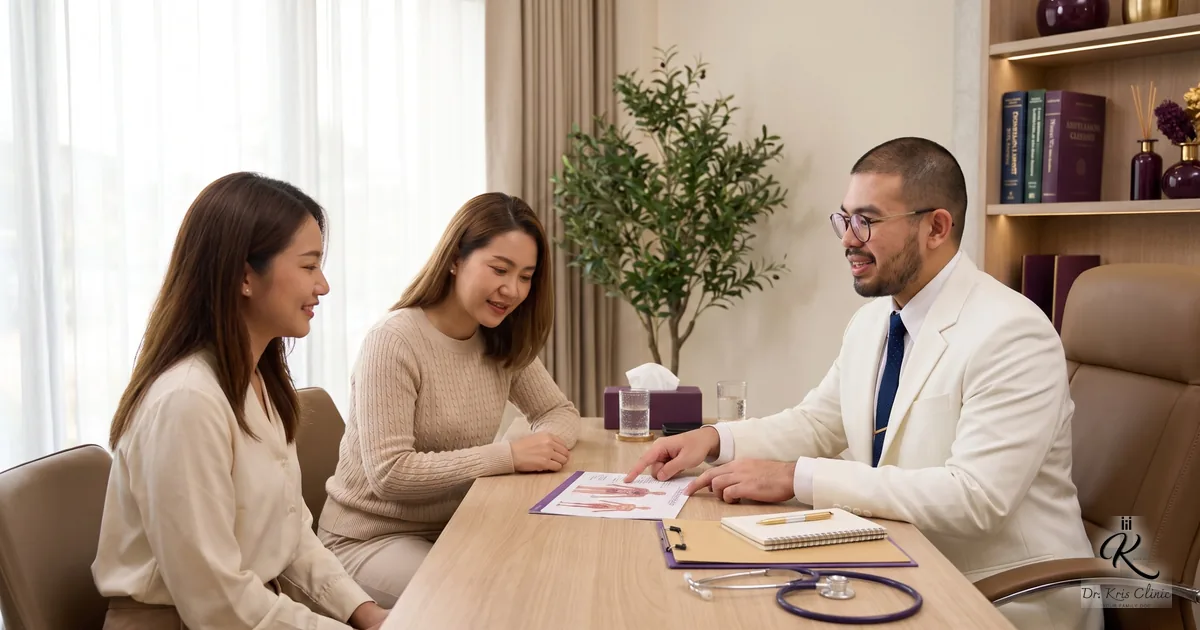
I always start by talking. A physical examination is done only when you are ready. You control the pace and can ask to stop at any time, and in some cases we start with an external look only. A good examination should make you feel safer, not more afraid.
What treatments are available?
- Treating physical causes, such as treating infection, local oestrogen for dryness, and local anaesthetic in some cases, as prescribed by a doctor.
- Pelvic floor physiotherapy teaches you to recognise and relax the muscles, with breathing and relaxation. It has good evidence for reducing pain.
- Vaginal dilators: training one size at a time, when you are relaxed and entirely in control, to teach your body again that penetration does not have to hurt.
- Cognitive behavioural therapy (CBT) and sex therapy help reduce fear and change the cycle.
- Pausing penetration for a while and coming back to closeness without a goal, such as sensate focus, can greatly reduce pressure.
- Botulinum toxin injections into the muscle have been studied in vaginismus that has not responded to other treatment. This is off-label use and must be done by an experienced doctor.
Getting to know your own body gradually helps too, and some women safely use devices as part of their practice. Read sex toys and masturbation, safely.
Treat physical causes
- Treat infections
- Local oestrogen when dry
Pelvic floor physiotherapy
- Learn to relax the muscles
- Breathing and relaxation
Graded dilators
- Practise one size at a time
- You stay in full control
Mind and partner
- CBT and sex therapy
- Pause penetration for now; sensate focus
All treatment is as assessed by your doctor, at a pace you are ready for.
If you are the partner of someone who has pain
What helps most is to believe them when they say it hurts, stop immediately when asked, do not blame, and learn together. Intimacy can take many forms that do not involve penetration. If talking is difficult, read common couple problems and how to talk them through.
When to see a doctor
- Pain almost every time, or penetration is not possible at all
- Deep pelvic pain, unusually severe period pain, or bleeding after sex
- Fever, unusual discharge or sores on the genitals
- The pain began after being forced or abused. If you need urgent help in Thailand, call 1300 (social assistance hotline) or 191 (police), and 1323 (free mental-health hotline; Thai language, ask for English support)
At Dr. Kris Clinic, we provide care with understanding, without rushing and without judgement, assessing the body, mind and relationship, and referring you to pelvic floor physiotherapy or a gynaecologist when needed. English-speaking consultations are available in person or online.
Related case stories from Dr. Kris
Dr. Kris Case: She Was So Quiet I Didn't Know How She FeltSilence is not consent; open a safe conversation and make room for the partner to get care tooMedicines and services your doctor may consider
Prices are per pack. Every medicine is prescribed only after a doctor's assessment; your doctor will advise whether it suits you. See all medicines & services
Want help with this? Three simple steps
Reading is a good start. When you are ready, check where you are, see how a consultation works, then book a time that suits you.
 1Free 2-minute self-checkSexual-health self-check — see your result instantly and send it to the doctor if you like.Start the self-check →
 2See the steps and feesIndividual from 990 THB · couple 1,590 THB · 30–60 minutes, at the clinic or online via MCS Telemedicine.How a consultation works →
 3Book with the doctorPick a time online or message us on LINE. Come on your own or with your partner. Payment confirms the booking.Book online →
Self-checks are a guide only and do not replace a doctor's assessment. Outcomes vary from person to person, depending on the severity of symptoms, the complexity of the problem and other factors.
Talk about sexual health without embarrassment
A doctor who listens and assesses body, hormones and relationship. In clinic or online.
Every medicine and service requires a doctor's assessment first.
Frequently asked questions
Is vaginismus just because I overthink?
It is not just overthinking. The muscle tightening is an involuntary reaction, usually with both physical and psychological factors involved, and it can be treated step by step.
I have never had an internal examination because I am too scared. What should I do?
Tell the doctor honestly that you are afraid. The examination can be postponed, or you can start with talking and an external examination. You control the pace and can ask to stop at any time.
How long does treatment take?
It varies. Many women see changes within a few weeks to several months with regular practice. Consistency matters more than speed.
I want to have a baby but penetration is not possible. What can I do?
Treat GPPPD alongside your planning, and talk to a doctor about options for conceiving. Most treatment works well once the pressure is reduced.
อ่านบทความนี้เป็นภาษาไทย
เจ็บขณะมีเพศสัมพันธ์ และภาวะช่องคลอดหดเกร็ง (Vaginismus/GPPPD) →
References
- American Psychiatric Association. DSM-5-TR. 2022 (Genito-Pelvic Pain/Penetration Disorder).
- Bornstein J, et al. 2015 ISSVD, ISSWSH and IPPS Consensus Terminology and Classification of Persistent Vulvar Pain and Vulvodynia. J Sex Med. 2016;13(4):607-612.
- Pacik PT. Botox treatment for vaginismus. Plast Reconstr Surg. 2009;124(6):455e-456e.
- Morin M, et al. Multimodal physical therapy versus topical lidocaine for provoked vestibulodynia: a multicenter, randomized trial. Am J Obstet Gynecol. 2021;224(2):189.e1-189.e12.
- Goldstein AT, et al. Vulvodynia: Assessment and Treatment. J Sex Med. 2016;13(4):572-590.
This article is for education and does not replace diagnosis or treatment by a doctor. If you have symptoms or concerns, please see a doctor.