FSIAD: Female Sexual Interest/Arousal Disorder Explained
When both desire and arousal have been missing long enough to cause distress, you are not imagining it, and it is not because you are "not sexy enough".

Key points
- FSIAD is diagnosed when at least 3 of 6 symptoms last at least 6 months and cause distress.
- The causes are usually mixed: medicines, hormones, pain, stress and the relationship.
- Treatment usually works best when the body, the mind and the couple are all looked after together.
Imagine you once had a "want" button and an "excited" button, and one day neither of them works very well. Your partner suggests sex and you feel indifferent; touch does not feel like much, even though you still love each other. Many women blame themselves for being abnormal, and some are judged by their partner as "cold". I want you to know that this condition has a name, has criteria, and can be helped.
What is FSIAD?
FSIAD stands for female sexual interest/arousal disorder. The name was introduced in DSM-5 in 2013 and is still used in DSM-5-TR (2022). It combines two things that often happen together: desire and arousal.
They were combined because, for many women, desire and arousal are closely intertwined: arousal leads to desire, and desire makes arousal easier.
The DSM-5-TR criteria (plain-language version)
There must be at least 3 of the following 6, clearly reduced or almost absent:
- Interest in sexual activity
- Sexual thoughts or fantasies
- Initiating sex, and being receptive when a partner initiates
- Excitement or pleasure during sexual activity (almost every time, about 75–100% of occasions)
- Interest or arousal in response to sexual cues, whether images, words or fantasies
- Sensations in the genitals or elsewhere in the body during sexual activity (almost every time)
In addition, it must:
- have lasted at least 6 months
- cause clear distress
- not be better explained by another mental health condition, violence in the relationship, or the effect of a medicine or physical illness alone
The doctor will also note whether it has always been present or is recent, whether it happens in all situations or only some, and how severe it is. This information helps guide treatment.
Interest
- Interest in sexual activity
Thoughts
- Sexual thoughts or fantasies
Initiating
- Starting it, or responding when a partner invites
Pleasure during activity
- Almost every time (about 75-100%)
Response to cues
- Visual, verbal or imagined
Body sensations
- Genital or other, during activity
Must last at least 6 months and cause clear distress. No distress means it is not a disorder.
Why does it happen?
Physical factors
- Hormonal changes, such as menopause, removal of the ovaries, and after childbirth and while breastfeeding
- Vaginal dryness or pain, which teach the body not to respond. Read vaginal dryness and painful sex
- Medicines, especially SSRI antidepressants, some contraceptive pills and anti-hormone treatments
- Chronic conditions such as diabetes, thyroid disease and chronic pain, and lack of sleep
Psychological factors
- Depression, anxiety, accumulated stress
- Lack of confidence in your body, especially after childbirth. Read body image and confidence after childbirth
- Difficult sexual experiences or past abuse
- Beliefs that sex is wrong or shameful
Relationship factors
- Built-up conflict, feeling unheard
- Sex that does not meet your needs, is rushed or lacks enough stimulation
- Housework and childcare falling on one person
Treatment: no single formula for everyone
Caring for the body
- Treat pain and dryness first, for example with lubricants, vaginal moisturisers or local oestrogen, as a doctor assesses
- Review and adjust medicines that affect sexual function together with the prescribing doctor
- For menopausal women whose main problem is reduced desire, low-dose testosterone may be considered. Read testosterone in women
Caring for the mind
- CBT helps change thoughts that dampen arousal, such as "I have to get this over with" or "my body isn't attractive"
- Mindfulness has been studied in women with desire and arousal problems and was found to help them notice bodily sensations and reduce distress. See mindfulness and sex
Caring for the relationship
- Set aside time for closeness with no goal of having sex, such as sensate focus exercises
- Talk about what makes you feel safe, relaxed and wanting to be close
- Share the household load, because exhaustion is one of the most direct passion-killers there is
Body
- Treat pain and dryness first
- Review medicines with the prescriber
- After menopause, hormones may be considered as assessed by your doctor
Mind
- CBT to shift thoughts that dampen mood
- Mindfulness
Relationship
- Sensate focus
- Talk about safety and closeness
- Share the household load
When to see a doctor
If the problem has lasted several months, distresses you or affects your relationship, or comes with pain, unusual bleeding or low mood, it deserves an assessment. If you have thoughts of harming yourself, call 1323, Thailand's free mental-health hotline (Thai language; ask for English support).
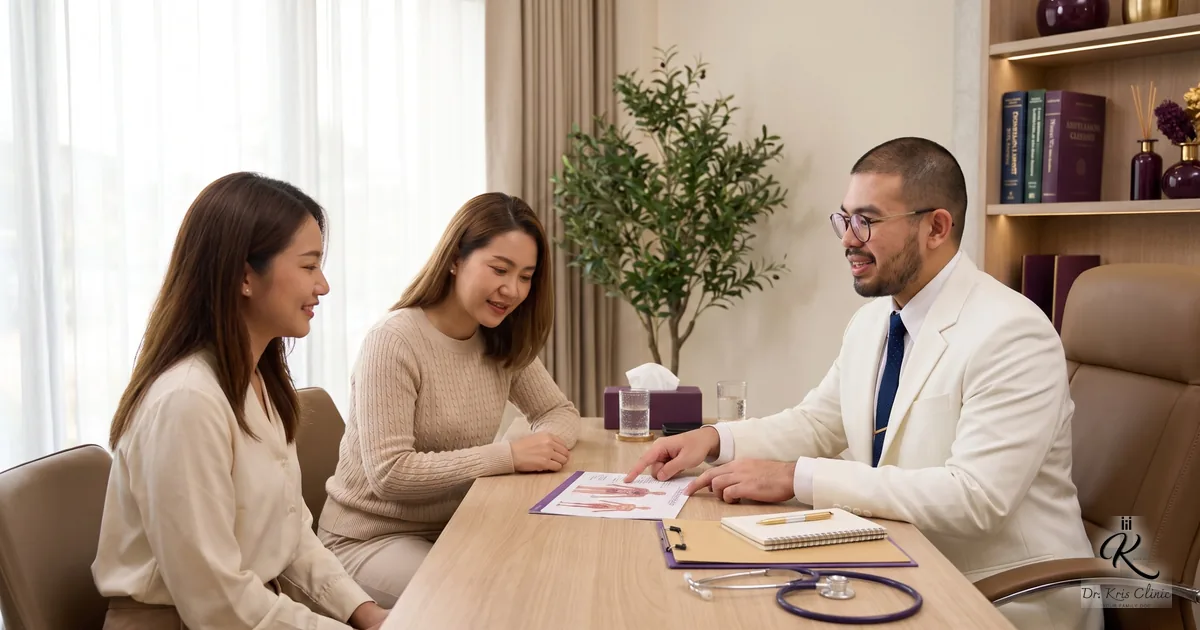
At Dr. Kris Clinic, I take time to talk things through, to work out which parts come from the body and which from the mind or the relationship, and then make a plan that fits your real life. English-speaking consultations are available in person or online. For a wider overview, read low sexual desire (HSDD).
Medicines and services your doctor may consider
Prices are per pack. Every medicine is prescribed only after a doctor's assessment; your doctor will advise whether it suits you. See all medicines & services
Want help with this? Three simple steps
Reading is a good start. When you are ready, check where you are, see how a consultation works, then book a time that suits you.
 1Free 2-minute self-checkSexual-health self-check — see your result instantly and send it to the doctor if you like.Start the self-check →
 2See the steps and feesIndividual from 990 THB · couple 1,590 THB · 30–60 minutes, at the clinic or online via MCS Telemedicine.How a consultation works →
 3Book with the doctorPick a time online or message us on LINE. Come on your own or with your partner. Payment confirms the booking.Book online →
Self-checks are a guide only and do not replace a doctor's assessment. Outcomes vary from person to person, depending on the severity of symptoms, the complexity of the problem and other factors.
Talk about sexual health without embarrassment
A doctor who listens and assesses body, hormones and relationship. In clinic or online.
Every medicine and service requires a doctor's assessment first.
Frequently asked questions
What is the difference between FSIAD and HSDD?
HSDD focuses on reduced desire, while FSIAD in DSM-5-TR combines desire and arousal in women. Some bodies, such as ISSWSH and ICD-11, still use HSDD separately. Both concepts centre on distress.
Does little lubrication mean I'm not aroused?
Not necessarily. Wetness also depends on hormones, medicines and your body. Some women are aroused but still dry, so using a lubricant is normal and does not mean you don't like your partner.
How long does treatment take?
It varies a lot. If the cause is clear, such as a medicine or dryness, things may improve within a few weeks. If it involves the mind or the relationship, it usually takes several months of consistent work.
อ่านบทความนี้เป็นภาษาไทย
FSIAD ภาวะไม่สนใจและไม่ตื่นตัวทางเพศในผู้หญิง คืออะไร รักษาอย่างไร →
References
- American Psychiatric Association. Diagnostic and Statistical Manual of Mental Disorders, Fifth Edition, Text Revision (DSM-5-TR). 2022.
- Brotto LA. The DSM diagnostic criteria for hypoactive sexual desire disorder in women. Arch Sex Behav. 2010;39(2):221-239.
- Brotto LA, Basson R. Group mindfulness-based therapy significantly improves sexual desire in women. Behav Res Ther. 2014;57:43-54.
- Parish SJ, et al. The ISSWSH process of care for the identification of sexual concerns and problems in women. Mayo Clin Proc. 2019;94(5):842-856.
This article is for education and does not replace diagnosis or treatment by a doctor. If you have symptoms or concerns, please see a doctor.