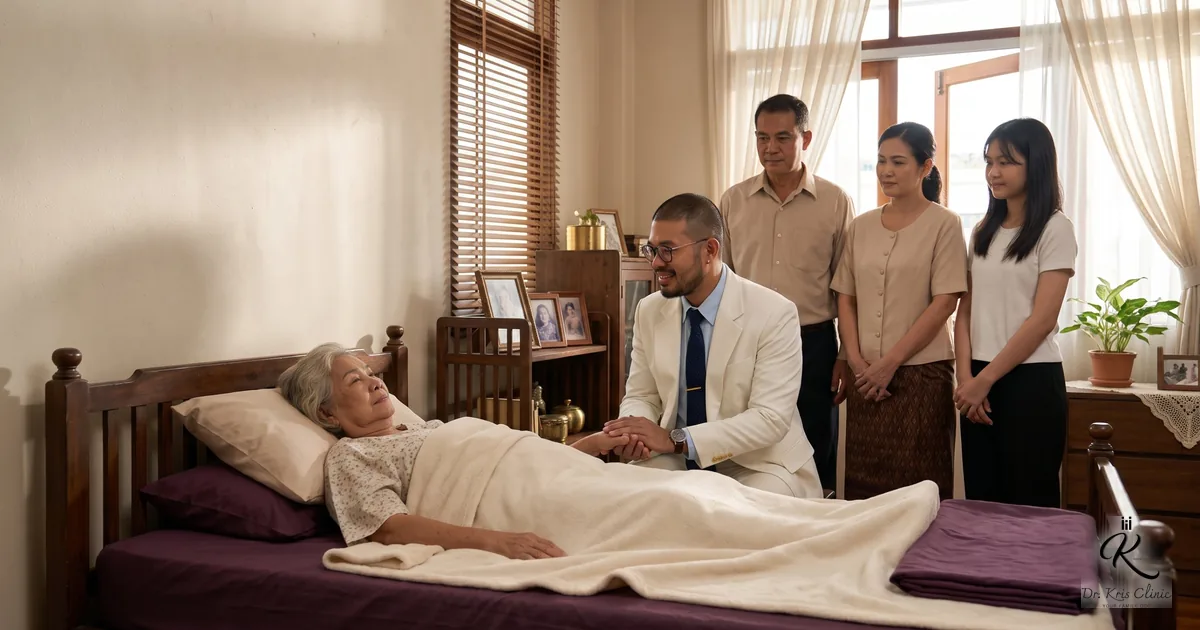
Family Therapy and Family Conferences: How They Help
When the problem is not one person but the way the whole household lives together, family therapy and family conferences help everyone turn towards each other.



Key points
- Family therapy sees problems as part of the family system rather than blaming any one person.
- There is evidence that it helps problems in children, teenagers and adults, such as conflict, alcohol problems and chronic illness.
- A family conference is a structured meeting between the medical team and the family to plan care together.
As a family physician, I often see one person fall ill while the whole household is affected. A teenager with behaviour problems often lives in a home where the parents are in conflict. An older person who is seriously ill often has children and grandchildren who disagree about treatment. In these situations, talking to one person is usually not enough; we need to talk with the whole family.
What is family therapy?
Family therapy is a way of helping that sees the family as a system: one person's behaviour always affects the others and is affected by them. The goals are:
- for family members to understand each other better
- to communicate safely, without hurting each other
- to adjust roles and find solutions together
It is not mediation or judging who is wrong, and it does not treat the person with the "symptoms" as the only cause.
Who provides it?
Family therapy is provided by people trained in this work, such as family therapists, clinical psychologists, psychiatrists and family physicians, who are trained in caring for patients in the context of their families and in running family meetings. In very complex situations, such as violence or severe mental illness, professionals work together as a team.
What can it help with?
| Situation | Examples |
|---|---|
| Conflict at home | Parents and teenagers, husband and wife, several generations under one roof |
| Problems in children and teenagers | Behaviour, schoolwork, substance use, phone use; read sex education for parents of teenagers |
| Life transitions | Divorce, remarriage, a first baby, a child coming out as LGBTQ+ |
| Illness | Chronic disease, dementia, end-of-life care |
| Loss | A death in the family |
Reviews by Alan Carr (2019) in the Journal of Family Therapy concluded that systemic family therapy has supporting evidence across many problem groups in both children and adults, such as behaviour problems, eating disorders, alcohol problems and marital conflict.
What happens in therapy
- Everyone gets to speak from their own point of view in a safe space.
- The therapist helps you see repeating patterns, such as one person nagging more while the other withdraws more.
- You practise listening and expressing your needs.
- Roles are reviewed: who is carrying too much, and who is being shut out.
- You make agreements that everyone can realistically keep, and then follow up.
- 1One person nagsFeels unheard
- 2Other withdrawsFeels blamed
- 3Nagging increasesBecause there is no response
- 4Withdrawal deepensThe cycle continues
Therapy helps you see the pattern without judging who is at fault.
Family conference: a structured family meeting
A family conference, or family meeting, is a sit-down conversation between the medical team and the family to plan important matters, such as:
- caring for someone who is seriously ill or near the end of life; read palliative care
- decisions about treatment or life support, and making a living will under section 12 of Thailand's National Health Act
- sharing out care responsibilities for an older person or someone with dementia
- planning for after discharge from hospital
The main steps
- Prepare. The team agrees beforehand on the goal of the meeting and who should attend, and asks the patient who they want to receive information.
- Introductions and a shared goal. Everyone knows what today's conversation is about.
- Ask how the family understands the situation before giving new information.
- Give information honestly and in plain language, pausing so the family has time to feel and to ask questions.
- Explore the patient's values and wishes. If the patient cannot speak for themselves, ask, "If they could speak, what would they want?"
- Discuss the options and plan together: who does what, and when.
- Summarise and record. Arrange follow-up and give contact details for questions.
The clinical practice guidelines for family meetings in palliative care by Hudson and colleagues (2008) state that well-prepared meetings reduce family distress and help decisions match the patient's wishes more closely.
- 1PrepareSet goals, who attends, who the patient wants informed
- 2Ask what they understandHow the family sees the situation before giving new information
- 3Give clear informationPause to allow feelings and questions
- 4Explore patient's valuesIf they could speak, what would they want?
- 5Plan and summariseWho does what, when; record and schedule follow-up
Hudson et al. (2008): well-prepared meetings reduce family distress.
When to seek help
- Arguments at home are so bad that someone avoids coming home
- A child or teenager's behaviour has changed a lot
- The family disagrees about caring for a sick or older relative
- There has been a loss and the family cannot move on
Getting help at Dr. Kris Clinic and Kris Care Space
We provide family counselling and help arrange family conferences, drawing on family medicine together with Kris Care Space's activity therapy, which helps family members who find talking hard to communicate in other ways. Sessions can be held in English. Read more in family medicine: one doctor for the whole family.
Medicines and services your doctor may consider
- Doctor consultation, 30–60 min฿990Details & order →
- Couple consultation, 30–60 min฿1,590Details & order →
Prices are per pack. Every medicine is prescribed only after a doctor's assessment; your doctor will advise whether it suits you. See all medicines & services
Want help with this? Three simple steps
Reading is a good start. When you are ready, check where you are, see how a consultation works, then book a time that suits you.
 1Free 2-minute self-checkRelationship check (CSI-4) — see your result instantly and send it to the doctor if you like.Start the self-check →
 2See the steps and feesIndividual from 990 THB · couple 1,590 THB · 30–60 minutes, at the clinic or online via MCS Telemedicine.How a consultation works →
 3Book with the doctorPick a time online or message us on LINE. Come on your own or with your partner. Payment confirms the booking.Book online →
Self-checks are a guide only and do not replace a doctor's assessment. Outcomes vary from person to person, depending on the severity of symptoms, the complexity of the problem and other factors.
See a family doctor
Care for the whole person and the whole family, including advance care planning and palliative care.
Every medicine and service requires a doctor's assessment first.
Frequently asked questions
Does everyone have to come?
Not from the first session. You can start with those who are ready and invite others later. Sometimes the therapist also sees some members separately.
Can it help if someone in the family won't admit there is a problem?
Yes. Changes in the people who attend usually affect the whole system, and often those who refused at first join later.
Does a family conference have to be held in hospital?
No. It can be held at a clinic, at home, or by video call for relatives who live far away. What matters is preparation and a clear structure.
อ่านบทความนี้เป็นภาษาไทย
References
- Carr A. Family therapy and systemic interventions for child-focused problems: the current evidence base. J Fam Ther. 2019;41(2):153-213.
- Carr A. Couple therapy, family therapy and systemic interventions for adult-focused problems: the current evidence base. J Fam Ther. 2019;41(4):492-536.
- Hudson P, Quinn K, O'Hanlon B, Aranda S. Family meetings in palliative care: multidisciplinary clinical practice guidelines. BMC Palliat Care. 2008;7:12.
- McDaniel SH, Campbell TL, Hepworth J, Lorenz A. Family-Oriented Primary Care. 2nd ed. Springer; 2005.
This article is for education and does not replace diagnosis or treatment by a doctor. If you have symptoms or concerns, please see a doctor.