Can You Have Children With HIV? Planning Safely for Baby and Partner
People with HIV, women and men, can have healthy children without HIV. What it takes is planning ahead with a doctor and taking treatment consistently.


Key points
- When the mother takes antiretroviral treatment consistently and the virus stays controlled throughout pregnancy, the chance of the baby being infected is below 1%.
- Men with HIV who stay virally suppressed can plan a pregnancy with an HIV-negative partner without passing on HIV, according to U=U.
- In Thailand formula feeding is still recommended instead of breastfeeding, and the baby receives preventive medicine and HIV tests as scheduled.
"If I have HIV, can I have children?" is a question full of hope and fear at the same time. I want to answer clearly from the start: yes, you can. Today, people with HIV, both women and men, can have healthy children who do not have HIV. What it takes is planning ahead with a doctor and taking treatment consistently.
Why it is safe to have children today
- U=U: when the partner with HIV takes treatment until their viral load is undetectable and stays that way, HIV is not passed on through sex. (Read U=U.)
- Prevention of mother-to-child transmission (PMTCT): when the mother takes medicine throughout pregnancy and the virus is undetectable near delivery, the chance of the baby being infected falls from about 15–45% in the past (without care) to below 1%.
- Thailand has done it: in 2016 the World Health Organization validated Thailand as the first country in Asia to eliminate mother-to-child transmission of HIV and syphilis.
For women with HIV
Before pregnancy
- Take antiretroviral treatment until your viral load is undetectable before you start trying for a baby.
- Discuss your regimen with your doctor. The WHO recommends dolutegravir-based regimens such as TLD for women planning pregnancy and for pregnant women.
- Get tested for other infections that may affect the baby, such as syphilis and hepatitis B, and start folic acid in advance.
During pregnancy and birth
- Start antenatal care early, take your medicine every day without missing doses, and have viral load tests as scheduled, especially near delivery.
- If the virus is undetectable near delivery, most women can give birth vaginally according to obstetric indications. If the viral load is still high, the doctor may consider a caesarean section and give extra medicine during labour.
- Women who first learn they have HIV during pregnancy can still prevent transmission by starting treatment as soon as possible.
After the birth
- The baby receives a short course of antiretroviral medicine after birth, with the type and length depending on the risk, and HIV tests as scheduled during the first year.
- Breastfeeding: Thailand's guidelines still recommend formula feeding instead of breastfeeding, and the government provides formula for babies born to mothers with HIV. This is because U=U applies to sex and does not yet cover breastfeeding. Some countries are starting to allow mothers with very well-controlled virus to decide together with their doctor. Talk to the doctor caring for you before deciding.
- The mother must keep taking her medicine after the birth, because this is a time when many people miss doses through exhaustion.
- 3–6 months beforePlan with your doctor
Take medicine until viral load is undetectable; test for syphilis, hepatitis B; take folic acid
- PregnancyEarly antenatal care, daily medicine
Viral load tests as scheduled; prevention still works if you learn your status while pregnant
- Near deliveryViral load check
If undetectable, vaginal birth is usually possible; if still high, a caesarean may be considered
- After birthBaby gets short-term medicine
Thailand advises formula over breastfeeding; formula is state-supported
- First yearBaby's HIV tests as scheduled
Keep taking your medicine; don't let tiredness lead to missed doses
When the mother stays suppressed throughout pregnancy, the baby's chance of infection is under 1%.
For men with HIV whose partner does not have HIV
- If the man has had an undetectable viral load continuously for at least 6 months, confirmed by viral load results, the couple can conceive naturally without passing on HIV, according to U=U.
- If the virus is not yet controlled, or the couple wants extra reassurance, the woman can use PrEP while trying to conceive, as assessed by a doctor.
- Other options, such as sperm washing with insemination or IVF, are used in some cases, for example when the virus is still detectable or there is also a fertility problem.
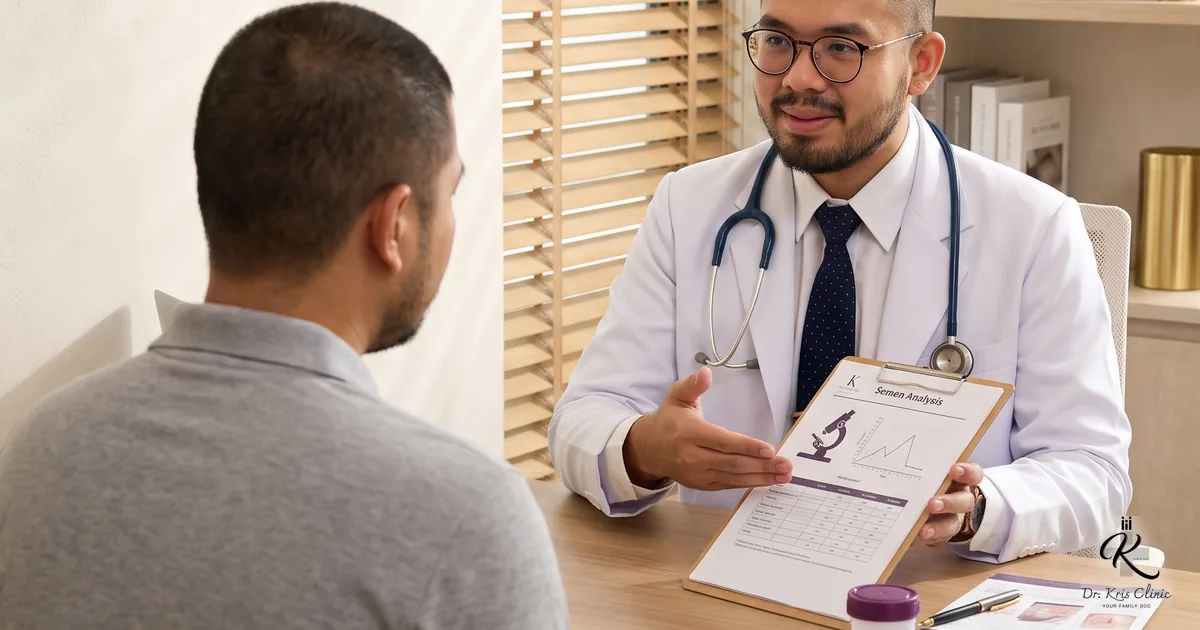
- If you have been trying without success, a semen test is worth considering. (Read Semen analysis.)
Couples where both partners have HIV, or the woman has HIV and the man does not
The principle is the same: the partner with HIV takes treatment until undetectable before starting to try for a baby. If the woman has HIV and the man does not, once she keeps her virus controlled, sex around ovulation does not pass HIV to him, and there is also the option of self-insemination of his semen into the vagina around ovulation. For couples where both have HIV, both should keep their virus controlled, for the health of both parents and the baby.
While you are not yet ready for a baby
If you do not want a pregnancy yet, use contraception as well. Dolutegravir-based regimens can generally be used with hormonal contraception, but some antiretroviral regimens (such as efavirenz) reduce the effectiveness of contraceptive implants, so always tell your doctor which contraception you use. Condoms also help prevent other sexually transmitted infections, and it is worth getting tested together as a couple before planning a baby.
Let me help you plan your family
At Dr. Kris Clinic in Surat Thani, I provide family medicine care, from counseling couples with different HIV status, reviewing viral load results and testing for sexually transmitted infections before pregnancy, to providing PrEP for the HIV-negative partner and coordinating referral to an obstetrician and the right hospital once you are pregnant. You are welcome to come as a couple, at the clinic or online, and English-speaking consultations are available.
Want help with this? Three simple steps
Reading is a good start. When you are ready, check where you are, see how a consultation works, then book a time that suits you.
 1Free 2-minute self-checkSexual-health self-check — see your result instantly and send it to the doctor if you like.Start the self-check →
 2See the steps and feesIndividual from 990 THB · couple 1,590 THB · 30–60 minutes, at the clinic or online via MCS Telemedicine.How a consultation works →
 3Book with the doctorPick a time online or message us on LINE. Come on your own or with your partner. Payment confirms the booking.Book online →
Self-checks are a guide only and do not replace a doctor's assessment. Outcomes vary from person to person, depending on the severity of symptoms, the complexity of the problem and other factors.
Ongoing HIV care
Antiretroviral treatment, lab results and daily life, in a space without judgement.
Every medicine and service requires a doctor's assessment first.
Frequently asked questions
If a mother has HIV, will her baby be infected?
If the mother takes medicine consistently and her virus stays undetectable throughout pregnancy, and the baby receives preventive medicine after birth, the chance of the baby being infected is below 1%.
Can a man with HIV conceive naturally?
Yes. If his virus has been undetectable for at least 6 months and this is confirmed by tests, his partner will not be infected, according to U=U. PrEP may also be used as assessed by a doctor.
Can a mother with HIV breastfeed?
Thailand's guidelines still recommend formula feeding instead, because there is still a risk of transmission through breast milk, even if low. Decide together with the doctor caring for you.
Is TLD safe during pregnancy?
The WHO recommends dolutegravir-based regimens for pregnant women and women planning pregnancy. Follow-up data show a very low risk to babies, but plan ahead with your doctor.
อ่านบทความนี้เป็นภาษาไทย
References
- World Health Organization. WHO validates elimination of mother-to-child transmission of HIV and syphilis in Thailand. Press release, 7 June 2016
- World Health Organization. Consolidated guidelines on HIV prevention, testing, treatment, service delivery and monitoring. Geneva: WHO; 2021
- Panel on Treatment of HIV During Pregnancy and Prevention of Perinatal Transmission. Recommendations for the Use of Antiretroviral Drugs During Pregnancy and Interventions to Reduce Perinatal HIV Transmission in the United States. clinicalinfo.hiv.gov (updated 2024)
- Department of Disease Control, Ministry of Public Health. Thailand National Guidelines on HIV/AIDS Diagnosis, Treatment and Prevention 2021/2022 (in Thai)
- Rodger AJ, et al. Sexual activity without condoms and risk of HIV transmission in serodifferent couples when the HIV-positive partner is using suppressive antiretroviral therapy (PARTNER). JAMA. 2016;316(2):171–181
This article is for education and does not replace diagnosis or treatment by a doctor. If you have symptoms or concerns, please see a doctor.