Vitamin C: What It Really Does for Colds, Skin and Sperm
Vitamin C is probably the most familiar supplement of all. Here is what it really does, what it doesn't, how much is enough and who should be careful with high doses.

Key points
- Taking vitamin C regularly doesn't prevent colds for most people and only shortens them slightly (about 8% in adults); starting it after you're sick doesn't clearly help.
- Adult men need 90 mg a day, women 75 mg, smokers about 35 mg more; colorful fruit and vegetables (a guava, peppers, kiwi) usually cover it without pills.
- Men with past kidney stones, people with kidney disease, iron overload or G6PD deficiency should be careful with high doses; IV vitamin C drips lack good evidence in healthy people.
Vitamin C is probably the supplement Thai people know best; many households always have a tube of effervescent tablets on hand. Our clinic page once wrote that vitamin C helps with everything from clearer skin to performance in bed. This time I want to rewrite it to match the evidence better, so you can spend your money and choose with understanding.
What vitamin C does in the body
Vitamin C (ascorbic acid) is a water-soluble vitamin that humans cannot make themselves. Its main jobs are:
- Building collagen, the structure of skin, blood vessels, gums and healing wounds
- Acting as an antioxidant
- Helping absorb iron from plant foods
- Working with the immune system
Severe deficiency causes scurvy: bleeding gums and slow-healing wounds. This is very rare, except in people who eat almost no fruit and vegetables, drink heavily or smoke a lot.
Separating beliefs from evidence
| Claim | What the evidence shows |
|---|---|
| Prevents colds | A Cochrane review found that taking it regularly does not reduce the chance of catching a cold in the general population, except in people doing very heavy exercise, such as marathon runners. |
| Helps you get over a cold faster | Taking it regularly shortens colds slightly, by about 8% in adults. Starting it after you are already sick doesn't clearly help. |
| Better, clearer skin | Some topical vitamin C formulas help a little with dark spots. Taking it by mouth only helps people who are deficient. |
| Improves sperm quality | Most research on antioxidants in infertile men is small and low quality. A larger randomized trial, MOXI (2020), found no improvement in sperm quality or pregnancy rates. |
| Reduces stress, raises testosterone, treats ED | No good enough evidence to recommend it. |
| Detoxes you after training or hormone use | No evidence, and it does not reduce the risks of steroids or performance-enhancing drugs (PEDs). |
If your problem is ED, infertility or low testosterone, looking for the cause will help far more than any vitamin pill.
Belief
- Take it and you won't catch colds
- Improves sperm quality
- Raises testosterone, fixes ED, relieves stress
- Detoxes after hormone use
The evidence
- Regular use doesn't lower the chance of a cold in the general public
- Colds about 8% shorter with regular use
- MOXI (2020) found no benefit for sperm
- No evidence for testosterone, ED or detox
Based on Cochrane reviews and the MOXI study (2020).
How much do you need a day?
| Group | Recommended daily amount |
|---|---|
| Adult men | 90 mg |
| Adult women | 75 mg |
| Smokers | About 35 mg extra |
| Upper limit (don't exceed) | 2,000 mg |
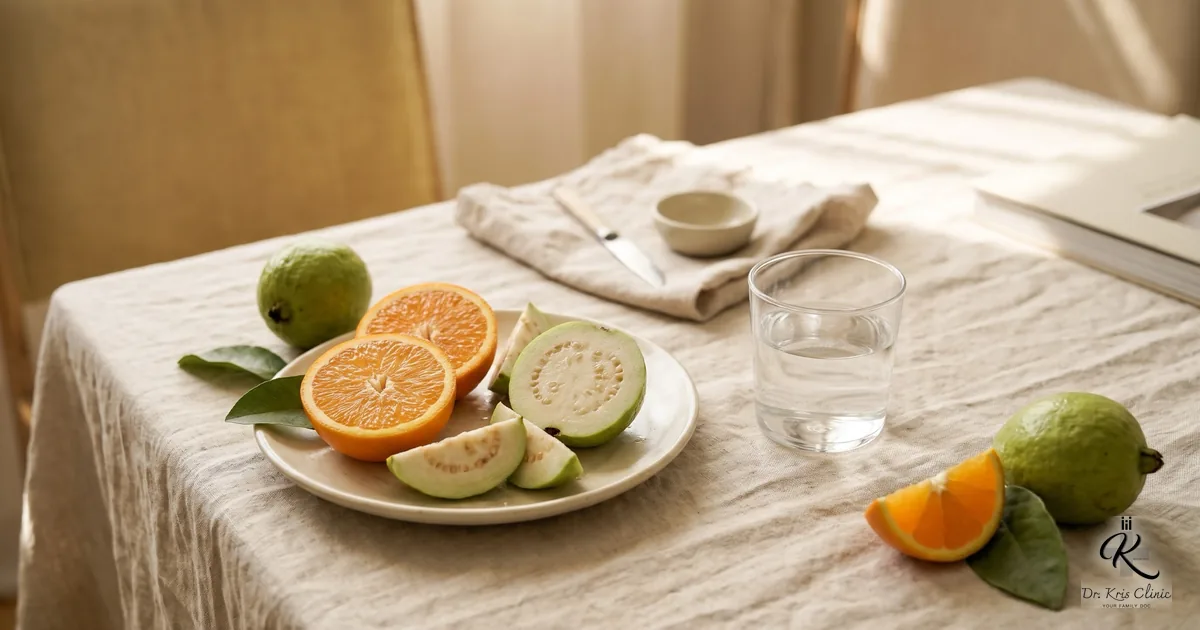
Foods high in vitamin C include guava (half a fruit is already over 100 mg), sweet peppers, kiwi, oranges, papaya, strawberries, broccoli and Chinese kale. Fresh produce is better than long-cooked, because vitamin C breaks down with heat.
The body absorbs a smaller share of vitamin C when you take a lot at once, and the excess is passed out in urine. So a 1,000 mg tablet doesn't give most people much more benefit than 200 mg.
Who should be careful with high-dose vitamin C
- Men who have had kidney stones. A study in Swedish men found that regularly taking vitamin C tablets was linked to about twice the rate of kidney stones, because vitamin C can be converted to oxalate.
- People with chronic kidney disease
- People with iron overload (hemochromatosis) or certain blood disorders
- People with G6PD deficiency. Very high intravenous doses can make red blood cells break down. This condition is fairly common in Thailand and Southeast Asia.
- Common side effects at high doses are diarrhea, stomach pain and heartburn.
Getting your money's worth
- Aim for colorful fruit and vegetables every day. Most people will get enough vitamin C without supplements.
- If you do supplement, 100–500 mg a day is enough for most people.
- Don't take several brands at once. Check whether your multivitamin, drinks and effervescent tablets already contain vitamin C.
- If you are vegetarian, taking vitamin C with meals helps you absorb iron better.
Read the bigger picture on supplements in Wellness and preventive health and Vitamin level testing: is it necessary?
When to see a doctor
If you catch colds unusually often, get repeated infections, have slow-healing wounds, bleeding gums or long-lasting fatigue, there may be another cause that needs checking, such as diabetes, anemia or a weakened immune system. At Dr. Kris Clinic I can review the supplements you take, assess what you really need, and plan care that matches your actual problem. English-speaking consultations are available in Surat Thani and online.
Want help with this? Three simple steps
Reading is a good start. When you are ready, check where you are, see how a consultation works, then book a time that suits you.
 1Free 2-minute self-checkSexual-health self-check — see your result instantly and send it to the doctor if you like.Start the self-check →
 2See the steps and feesIndividual from 990 THB · couple 1,590 THB · 30–60 minutes, at the clinic or online via MCS Telemedicine.How a consultation works →
 3Book with the doctorPick a time online or message us on LINE. Come on your own or with your partner. Payment confirms the booking.Book online →
Self-checks are a guide only and do not replace a doctor's assessment. Outcomes vary from person to person, depending on the severity of symptoms, the complexity of the problem and other factors.
Preventive health care
Plan check-ups, nutrition and supplements that fit your age and lifestyle.
Frequently asked questions
Does high-dose vitamin C help once I have a cold?
In most studies, starting it after you get sick doesn't clearly help. Rest, fluids and treating the symptoms matter more.
Is taking vitamin C every day for a long time dangerous?
Up to 2,000 mg a day is considered fairly safe for most people. Men who have had kidney stones, people with kidney disease or iron overload should talk to a doctor.
Does vitamin C make sperm stronger?
The evidence is weak, and a large randomized trial found no clear benefit. If you want a baby, have a semen analysis and look for the cause with a doctor.
อ่านบทความนี้เป็นภาษาไทย
References
- Hemilä H, Chalker E. Vitamin C for preventing and treating the common cold. Cochrane Database Syst Rev. 2013;(1):CD000980.
- Thomas LDK, et al. Ascorbic Acid Supplements and Kidney Stone Incidence Among Men: A Prospective Study. JAMA Intern Med. 2013;173(5):386-388.
- Steiner AZ, et al. The effect of antioxidants on male factor infertility: the Males, Antioxidants, and Infertility (MOXI) randomized clinical trial. Fertil Steril. 2020;113(3):552-560.
- NIH Office of Dietary Supplements. Vitamin C: Fact Sheet for Health Professionals (updated 2024).
This article is for education and does not replace diagnosis or treatment by a doctor. If you have symptoms or concerns, please see a doctor.