Transvestic Disorder and How It Differs from Being Transgender
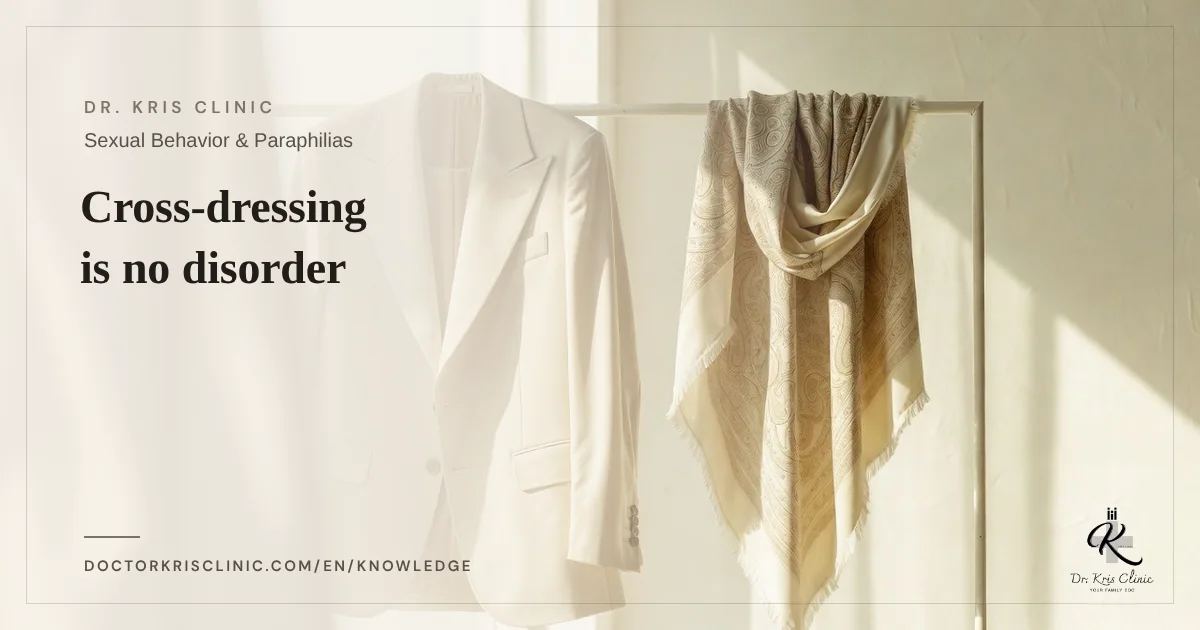
Cross-dressing is a diverse form of expression, and being transgender is an identity, not a sexual disorder. This article explains what transvestic disorder means and why it is a contested diagnosis.


Key points
- Cross-dressing is mostly a form of expression, not a disorder.
- Transvestic disorder is used only when cross-dressing is linked to sexual arousal for at least 6 months and causes distress or damage to your life.
- Being transgender is a gender identity, not a paraphilia, and ICD-11 has removed the transvestism diagnoses.
Phrases like "dressing as a woman" or "liking to wear clothes of the other sex" are often lumped together with very different things: genderless fashion, drag performance, certain sexual preferences and being transgender. This confusion leads to many people being stigmatised for no reason. This article separates these things clearly and explains who the diagnosis of transvestic disorder actually applies to.
This article is part of the Paraphilic Disorders series.
Four things that often get mixed up
| Topic | Meaning | Is it a disorder? |
|---|---|---|
| Gender expression | Clothing, hairstyle or mannerisms that may not match the gender role society expects | No |
| Drag and performance art | Dressing for performance, entertainment or artistic expression | No |
| Transgender identity | A person's inner sense of their gender, which does not match the sex they were assigned at birth | Not a paraphilia, and not a mental disorder in ICD-11 |
| Transvestic disorder | Cross-dressing linked to sexual arousal that causes distress or damage to your life | A diagnosis in DSM-5-TR |
Read more about identity in Gender identity: gender as a spectrum and its dimensions and Genderless fashion and gender expression.
Gender expression
Gender expression
- Clothing, hairstyle, mannerisms
- Not a disorder
Drag
Performance art
- For performance and entertainment
- Not a disorder
Transgender people
Transgender
- An inner identity
- Not a paraphilia, and not a mental disorder in ICD-11
Transvestic Disorder
DSM-5-TR
- Linked to sexual arousal
- And causes distress or harms life
Transvestic disorder in DSM-5-TR
DSM-5-TR (2022) diagnoses it when:
- There is intense, recurrent sexual arousal from cross-dressing, shown through fantasies, urges or behaviour, lasting at least 6 months.
- The interest causes clinically significant distress or impairment in daily life.
Clinicians may add the specifier "with fetishism" (arousal from fabrics or garments, close to a fetish) or "with autogynephilia" (arousal from thoughts or images of oneself as a woman), and may add "in a controlled environment" or "in full remission". In practice this diagnosis applies to very few people, because most people who cross-dress are not distressed by it. A Canadian survey (Joyal & Carpentier, 2017) found that about 6% of adults had experienced desires of this kind.
A preference vs a condition that needs treatment
- If cross-dressing makes you feel relaxed, happy or excited, and causes no distress and does not affect your life, it is expression or a preference, not a disorder.
- If those feelings bring intense shame, self-rejection, lost relationships, or preoccupation that harms your work, talking with a professional will help.
- Distress that comes only from society or your family not accepting you does not mean you are abnormal. It is still pain that deserves understanding care.
Treatment does not aim to "change" anyone's identity. WPATH SOC-8 affirms that gender diversity is not pathology.
Why this diagnosis is contested
I want to be frank: transvestic disorder is one of the most criticised diagnoses in this group.
- The concept of autogynephilia has been criticised for describing trans women's experiences too narrowly, and it has been used to deny their identities. Scholars point out that studies have found similar feelings in women who are not transgender, which makes the clinical meaning of the concept unclear (Moser, 2010; Serano, 2010).
- The World Health Organization's ICD-11 removed the diagnoses "fetishistic transvestism" and "dual-role transvestism", because they had too little clinical usefulness and caused stigma (Krueger et al., 2017).
- ICD-11 moved gender incongruence out of the chapter on mental disorders and into the chapter on conditions related to sexual health, so that transgender people can access services without being labelled as mentally ill.
- The WPATH Standards of Care, Version 8 (SOC-8, 2022) affirm that gender diversity is not a pathology.
So if you are transgender, or exploring your identity, having felt sexually aroused when dressing does not mean your identity is not real. Gender identity is about knowing who you are, not about sexual arousal.
Assessment and care
For people who are distressed by this, care begins with an affirming, non-judgmental conversation.
- Exploring where the distress comes from: feelings about yourself, fear of being found out, conflict with a partner, or questions about identity.
- Psychotherapy and sex therapy help reduce shame and find ways of expressing yourself that feel comfortable and safe.
- Couples therapy when your partner wants to understand and adjust together. See Common couple problems and how to talk them through.
- If you have questions about identity, gender-affirming care in line with WPATH SOC-8 is more appropriate. For information on hormones, read Gender-affirming hormone therapy (GAHT): starting safely.
This condition almost never needs medication, and no treatment should aim to "change" anyone's gender identity. Conversion therapy does not work and causes harm.
Where to get help
- Talk confidentially with a clinical sexologist. See When to see a clinical sexologist.
- 1323, Thailand's free mental-health hotline (Thai language; ask for English support), if you are distressed or having thoughts of harming yourself.
- For other sexual interests outside the main groups, read Other paraphilic disorders.
Dr. Kris Clinic offers services that are welcoming to people of all genders, including clinical sexology consultations and gender-affirming hormone care, at the clinic and online, including in English, without judgment.
Want help with this? Three simple steps
Reading is a good start. When you are ready, check where you are, see how a consultation works, then book a time that suits you.
 1Free 2-minute self-checkSexual-health self-check — see your result instantly and send it to the doctor if you like.Start the self-check →
 2See the steps and feesIndividual from 990 THB · couple 1,590 THB · 30–60 minutes, at the clinic or online via MCS Telemedicine.How a consultation works →
 3Book with the doctorPick a time online or message us on LINE. Come on your own or with your partner. Payment confirms the booking.Book online →
Self-checks are a guide only and do not replace a doctor's assessment. Outcomes vary from person to person, depending on the severity of symptoms, the complexity of the problem and other factors.
Confidential consultation with a clinical sexologist
Say what you haven't been able to say to anyone. We listen, assess and plan — or refer when needed.
Every medicine and service requires a doctor's assessment first.
Frequently asked questions
Is it abnormal for a man to like dressing as a woman?
No. Cross-dressing is a form of expression. It is considered a condition worth addressing only when it causes significant distress or damage to your life.
Is being transgender a paraphilia?
No. Being transgender is a gender identity, not a pattern of sexual arousal, and ICD-11 does not consider it a mental disorder.
If I've felt aroused when dressing as a woman, does that mean I'm not really trans?
No, it does not. Gender identity is about knowing yourself. Sexual feelings at certain times do not cancel out your identity.
Does transvestic disorder need to be treated with medication?
Generally not. The main care is conversation, psychotherapy and affirming sex therapy.
อ่านบทความนี้เป็นภาษาไทย
References
- American Psychiatric Association. DSM-5-TR. 2022. Transvestic Disorder (specifiers: with fetishism, with autogynephilia).
- World Health Organization. ICD-11 MMS. Gender incongruence (HA60–HA6Z) in Conditions related to sexual health.
- Krueger RB, Reed GM, First MB, et al. Proposals for Paraphilic Disorders in the ICD-11. Archives of Sexual Behavior. 2017;46(5):1529–1545.
- Coleman E, Radix AE, Bouman WP, et al. Standards of Care for the Health of Transgender and Gender Diverse People, Version 8. International Journal of Transgender Health. 2022;23(Suppl 1):S1–S259.
- Moser C. Blanchard's Autogynephilia Theory: A Critique. Journal of Homosexuality. 2010;57(6):790–809.
- Serano JM. The Case Against Autogynephilia. International Journal of Transgenderism. 2010;12(3):176–187.
This article is for education and does not replace diagnosis or treatment by a doctor. If you have symptoms or concerns, please see a doctor.