Blood Tests Before Starting TRT and During Follow-Up
Blood tests before TRT confirm that testosterone is genuinely low and set safety baselines. Learn what to test, how to prepare and how follow-up works.


Key points
- Confirm low testosterone with at least two fasting morning tests (07:00–10:00), adding SHBG when borderline.
- Find the cause with LH, FSH and prolactin, and record baselines such as haematocrit, PSA, sugar, lipids and blood pressure.
- On TRT, test at 3–6 months and then every 6–12 months; haematocrit over 54% or a sharp PSA rise needs action.
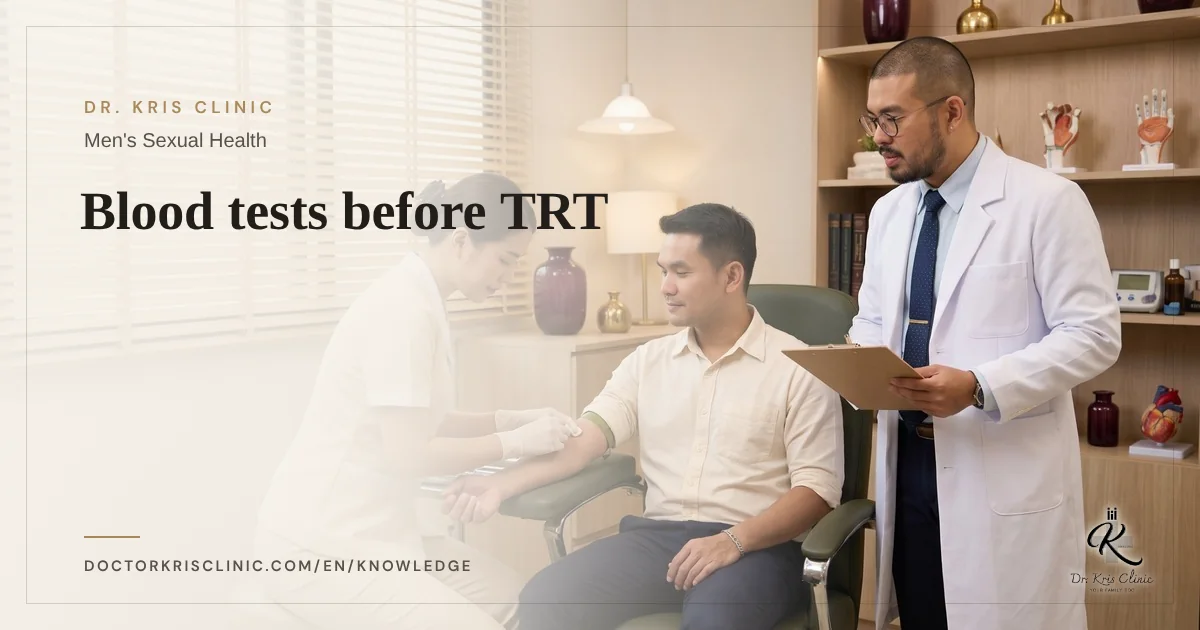
When a patient shows me a blood result taken at three in the afternoon after lunch and says, "My testosterone is low, I want to start injections right away," I usually have to ask them to test again. It's not that I don't believe them; a result taken at the wrong time can lead a man with normal levels to receive medicine he doesn't need. Blood tests before starting TRT therefore have two jobs: to confirm the diagnosis is real, and to record baseline values for safety comparisons later.
Step 1: Confirm that testosterone is genuinely low
- Total testosterone, drawn between 07:00 and 10:00 while fasting. If it is low, repeat it on another day. All guidelines require at least 2 tests.
- SHBG and albumin, to calculate free testosterone in men with borderline totals, obesity, older age, liver disease or thyroid problems. The 2026 EAU guidance supports wider use of SHBG testing to reduce misdiagnosis (read What is SHBG?).
- The lab should use a standardised method. The Endocrine Society recommends methods certified under the CDC Hormone Standardization (HoST) programme, because different labs can give different values.
Step 2: Find the cause
- LH and FSH: if high, the testicles can't produce enough (primary); if low or normal despite low testosterone, the brain is sending too few signals (secondary)
- Prolactin in secondary cases, to look for a pituitary tumour
- Depending on symptoms: iron studies (ferritin, transferrin saturation), thyroid (TSH), and in some men an MRI of the pituitary if testosterone is very low, prolactin is high, or there are eye symptoms and headaches
- Oestradiol when there is breast enlargement or tenderness (see Hormone imbalance in men)
- Semen analysis if you still plan to have children, because TRT suppresses sperm production (see Semen analysis)
Step 3: Baseline values for safety
| Test | Why it is needed |
|---|---|
| CBC, haematocrit | TRT increases red blood cells; if it starts above 50%, the cause must be found first |
| PSA and prostate examination | In men aged around 40–45 and over, or at higher risk, as a starting value |
| Blood sugar (FBS or HbA1c) | Low testosterone often occurs together with diabetes |
| Blood lipids | To assess cardiovascular risk |
| Liver and kidney function | To guide the choice of medicine and check for other conditions |
| Blood pressure | Since 2025 the FDA has required all testosterone products to carry a warning about raised blood pressure |
Besides blood results, I will ask about snoring and sleep apnoea, urinary symptoms, any history of blood clots, and heart disease, which matter just as much as the lab numbers.
1. Confirm it is truly low
- Morning total testosterone, twice
- SHBG, albumin if borderline
2. Find the cause
- LH, FSH
- Prolactin in selected men
- Estradiol if breasts enlarged
- Semen test if planning children
3. Safety baseline
- CBC, hematocrit
- PSA by age
- Glucose, lipids, liver, kidney
- Blood pressure
Preparing for your test
- Fast for at least 8 hours; plain water is fine.
- Come for your blood test between 07:00 and 10:00.
- Sleep well the night before, and avoid hard exercise and alcohol for 1–2 days beforehand.
- If you are ill, have a fever or have just had surgery, postpone the test.
- Tell us about every medicine and supplement, especially biotin, which interferes with some lab methods, and any hormones or "test boosters" you have used.
- If you have used steroids or hormones before, be honest. I'm not judging you, but I need to know to read the results correctly.
What to test on TRT, and when
| Time point | What is assessed |
|---|---|
| First 3–6 months | Whether symptoms have improved, side effects, testosterone level, haematocrit, PSA, blood pressure |
| Every 6–12 months once stable | Hormone level, haematocrit, blood pressure, and PSA according to age |
| Whenever there are unusual symptoms | Test straight away according to symptoms; no need to wait for your appointment |
The timing of the testosterone test depends on the form of medicine:
- Medium-acting injection (enanthate): test mid-way between injections, aiming for the middle of the normal range
- Long-acting injection (undecanoate): test just before the next injection
- Gel: test after at least 1–2 weeks of use, a few hours after applying
Examples of thresholds doctors use: a haematocrit above 54% means stopping or reducing the medicine and looking for the cause, while a PSA rise of more than 1.4 ng/mL within the first 12 months, a PSA above 4.0 ng/mL, or an abnormal prostate on examination should prompt referral to a urologist. Other side effects and how to manage them are in TRT side effects.
- Before startingConfirm diagnosis, baseline
Morning 7-10 am, fasting; repeat if low
- First 3-6 monthsFirst review
Symptoms, side effects, hormone level, hematocrit, PSA, blood pressure
- Every 6-12 monthsOnce stable
Hormone level, hematocrit, blood pressure, and PSA by age
- If symptoms ariseTest right away
No need to wait for an appointment
If hematocrit exceeds 54% or PSA rises quickly, your doctor will adjust treatment or refer you.
When to see a doctor, and how the clinic can help
If you already have old blood results, bring them for me to look at, and I'll tell you whether they can be used or whether you should test again. If you are using hormones but have never had any follow-up tests, get tested soon, especially if you have headaches, a flushed face, palpitations or breathlessness.
At Dr. Kris Clinic we offer blood tests before starting and during TRT in line with international guidelines, explain each result clearly and plan your follow-up appointments. Consultations in English are available. If you're not yet sure whether to start, read What is TRT and who is it for?, or if you'd like a general health check at the same time, see Health check-ups for working-age adults.
Related case stories from Dr. Kris
Dr. Kris Case: A Much Younger Partner, Hormones and ErectionsConfirm low testosterone before TRT, check the blood vessels when there is ED, and address the anxiety at the same timeMedicines and services your doctor may consider
- Pre-hormone / pre-TRT blood panel (7 tests)฿2,990Details & order →
- Testosterone blood test฿800Details & order →
Prices are per pack. Every medicine is prescribed only after a doctor's assessment; your doctor will advise whether it suits you. See all medicines & services
Want help with this? Three simple steps
Reading is a good start. When you are ready, check where you are, see how a consultation works, then book a time that suits you.
 1Free 2-minute self-checkSexual-health self-check — see your result instantly and send it to the doctor if you like.Start the self-check →
 2See the steps and feesIndividual from 990 THB · couple 1,590 THB · 30–60 minutes, at the clinic or online via MCS Telemedicine.How a consultation works →
 3Book with the doctorPick a time online or message us on LINE. Come on your own or with your partner. Payment confirms the booking.Book online →
Self-checks are a guide only and do not replace a doctor's assessment. Outcomes vary from person to person, depending on the severity of symptoms, the complexity of the problem and other factors.
Think your testosterone might be low?
Start with symptoms and proper blood tests with a doctor before deciding on TRT safely.
Every medicine and service requires a doctor's assessment first.
Frequently asked questions
How many hours should I fast before a hormone test?
About 8 hours of fasting is recommended, with blood taken between 7 and 10 a.m.; plain water is fine. If other tests such as lipids are done at the same time, your doctor may ask you to fast longer.
Can I test free testosterone alone?
This is not recommended. Direct free testosterone tests in ordinary labs are often inaccurate. Guidelines recommend total testosterone together with SHBG, with free testosterone calculated when needed.
I'm under 40. Do I need a PSA test?
Generally not, unless you are at high risk, for example a close relative who had prostate cancer at a young age. Your doctor will decide case by case.
How often do I need blood tests on TRT?
At first, about 3–6 months after starting, then at least once a year once stable, and any time if you have unusual symptoms.
อ่านบทความนี้เป็นภาษาไทย
References
- Bhasin S, et al. Testosterone Therapy in Men With Hypogonadism: An Endocrine Society Clinical Practice Guideline. J Clin Endocrinol Metab. 2018;103(5):1715–1744.
- Mulhall JP, et al. Evaluation and Management of Testosterone Deficiency: AUA Guideline. J Urol. 2018;200(2):423–432 (validity confirmed 2024).
- Corona G, et al. EAU Guidelines on Sexual and Reproductive Health: Summary of the 2026 Recommendations for Measurement and Biochemical Confirmation of Hypogonadism. Eur Urol Focus. 2026.
- U.S. Food and Drug Administration. FDA issues class-wide labeling changes for testosterone products. February 28, 2025.
- Endocrine Society. Statement on Testosterone Replacement Therapy. July 16, 2026.
This article is for education and does not replace diagnosis or treatment by a doctor. If you have symptoms or concerns, please see a doctor.