How Hard Is Normal? The Erection Hardness Score (EHS)
The Erection Hardness Score is a simple 1–4 scale that helps you and your doctor talk about firmness in the same language.

Key points
- The EHS is a one-question scale from 1 to 4 that doctors use worldwide to describe erection firmness.
- A change over time, such as dropping from level 4 to 3 or 2, matters as much as the number itself.
- The score is a starting point for a conversation, not a diagnosis; use it alongside the IIEF-5.
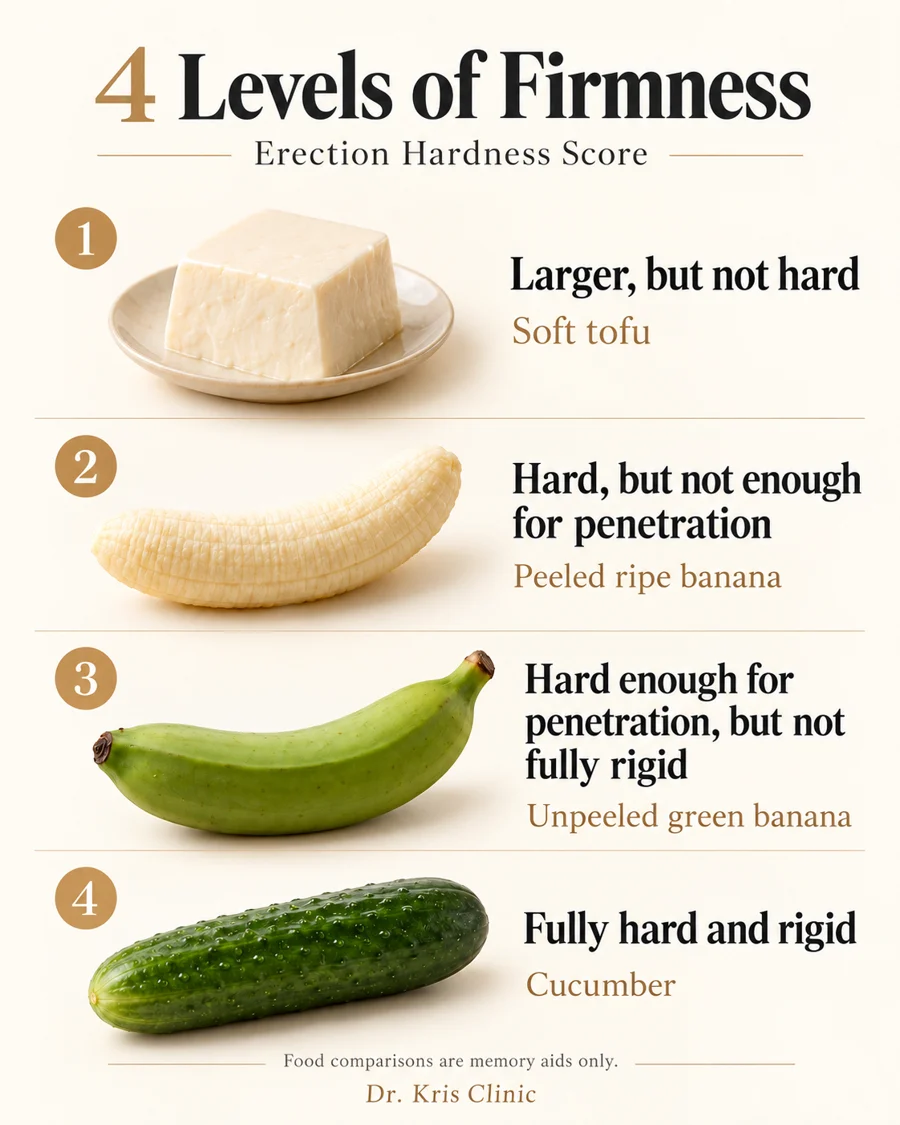
When men come to talk to me about erections, the hardest question to answer is "How hard?", because everyone uses different words. That is why doctors have a simple tool called the Erection Hardness Score (EHS). It is used worldwide in clinics and research, and it is the origin of the "tofu, banana, cucumber" comparison that many people have seen.
What is the Erection Hardness Score?
The EHS is a single-question scale. You choose the level that best matches how firm your erections have mostly been recently. It was validated by Mulhall and colleagues in 2007. Its strengths are that it is easy to use, it gives patient and doctor a shared language, and it can be used to track treatment.
The four levels of firmness
| Level | Medical meaning | Simple comparison |
|---|---|---|
| 1 | The penis is larger but not hard | Soft tofu |
| 2 | Somewhat hard, but not hard enough for penetration | A peeled ripe banana |
| 3 | Hard enough for penetration, but not completely hard | An unripe banana in its skin |
| 4 | Completely hard and fully rigid | A cucumber |
The food comparisons are only a memory aid and are not scientifically precise, but they make it easier for many men to talk about it.
Mulhall et al. (2007). The food comparisons are just a memory aid.
How to read your result
- Level 4 is good and is the goal of care.
- Level 3 allows penetration, but many men feel unsure of themselves. It may be mild ED, especially if you used to be at level 4.
- Level 2 makes penetration difficult and usually affects sexual satisfaction and confidence.
- Level 1 means almost no erection, and the cause should be looked into properly.
Just as important as the number is change. If you used to be at level 4 and have gradually slipped to 3 or 2 over several months, that is a signal to have your blood vessels, blood sugar, cholesterol and hormones checked.
How firmness changes with age
As men get older, the blood vessels and tissue of the penis become less elastic. Many men need longer stimulation and sometimes reach level 3 instead of level 4. The Massachusetts Male Aging Study found that around half of men aged 40–70 had some degree of ED. But "common with age" does not mean "something you have to put up with". If it affects your pleasure or confidence, get checked for hidden conditions such as diabetes, high blood pressure or high cholesterol.
What morning erections tell you
Waking up with an erection is part of the erections that happen during dreaming (REM) sleep, without any sexual arousal. That makes them a kind of "system test" of your blood vessels and nerves.
- Morning erections fading over time, along with less firmness in every situation, points towards a physical cause. The European Male Ageing Study found that fewer morning erections, lower sex drive and ED were the three symptoms most clearly linked to low testosterone.
- Poor sleep, alcohol and some medicines can temporarily reduce morning erections, so look at the trend over several weeks.
How to rate yourself so the information is useful
- Rate your overall picture over the past 4 weeks, not a single occasion.
- Notice whether it differs between sex with a partner, masturbation and waking up in the morning.
- Notice whether, once hard, the erection lasts long enough or softens halfway through.
- Note related factors, such as drinking alcohol, poor sleep or stress.
If you reach level 4 in the morning or during masturbation but only level 2 with a partner, this usually means your body still works, and anxiety or relationship factors are worth looking at. Read more in Stress, relaxation and erections.
Use it alongside the IIEF-5
The EHS tells you about "hardness", while the IIEF-5 questionnaire takes a wider view, covering confidence, how often penetration is possible, keeping the erection and satisfaction. Doctors often use both together, at the first assessment and at follow-up after treatment, for example after starting tadalafil or after lifestyle changes.
Using the EHS to track treatment
- Note your level before starting treatment, as a baseline.
- After starting medicine prescribed by your doctor, note your level each time you use it.
- Don't judge from the first attempt; assess after several correct attempts.
- Bring your notes to your doctor. The goal is level 4, or a level you and your partner are happy with. If you are not there yet, your doctor may adjust the dose, change the medicine or look for other causes.
An example from my clinic
A man in his early 50s came to see me because his erections had weakened over the past year. He was at level 2 and rarely woke with an erection. Tests showed a high long-term blood sugar (HbA1c). We treated his diabetes alongside medicine as assessed by the doctor, and he recorded his EHS score each time. About 3 months later, most of his scores were at level 3–4. Results differ from person to person, but the lesson is that firmness that slowly declines together with fading morning erections deserves a full health check.
Limitations to be aware of
- It is a self-assessment, so it depends on your feelings and memory.
- It does not tell you the cause, only a rough level of severity.
- It does not measure ejaculation, sexual desire or your partner's satisfaction.
The score is therefore a starting point for a conversation, not a diagnosis.
When to see a doctor
- Your erections are mostly at level 1–2, or have dropped from what they were for more than 3 months
- You also have diabetes, high blood pressure, high cholesterol, or you smoke
- You have lower sex drive and tire easily as well as erection problems, which may be linked to low testosterone
- Go to hospital immediately if an erection lasts more than 4 hours without arousal (in Thailand call 1669)
At Dr. Kris Clinic you can simply tell me which level you are at, no need to feel shy. We use this together with your history, a physical examination and blood tests to find the cause and plan the right care for you, in person in Surat Thani or online, in English if you prefer. For the full overview, read Erectile dysfunction (ED).
Medicines and services your doctor may consider
- Sidegra sildenafil 50 mg, GPO (4 tabs)฿350Details & order →
- Talafil-20 tadalafil 20 mg (4 tabs)฿1,990Details & order →
- Doctor consultation, 30–60 min฿990Details & order →
Prices are per pack. Every medicine is prescribed only after a doctor's assessment; your doctor will advise whether it suits you. See all medicines & services
Want help with this? Three simple steps
Reading is a good start. When you are ready, check where you are, see how a consultation works, then book a time that suits you.
 1Free 2-minute self-checkSexual-health self-check — see your result instantly and send it to the doctor if you like.Start the self-check →
 2See the steps and feesIndividual from 990 THB · couple 1,590 THB · 30–60 minutes, at the clinic or online via MCS Telemedicine.How a consultation works →
 3Book with the doctorPick a time online or message us on LINE. Come on your own or with your partner. Payment confirms the booking.Book online →
Self-checks are a guide only and do not replace a doctor's assessment. Outcomes vary from person to person, depending on the severity of symptoms, the complexity of the problem and other factors.
Worried about sexual performance?
Talk to a doctor in private. We look at physical, hormonal and vascular causes before choosing the treatment that suits you.
Every medicine and service requires a doctor's assessment first.
Frequently asked questions
Is level 3 considered ED?
Level 3 allows penetration but is not fully hard. It may be mild ED, especially if it has dropped from before or makes you feel unsure. It is best assessed together with the IIEF-5.
Is it abnormal not to wake up with an erection every day?
You don't need an erection every morning. But if morning erections have almost completely disappeared for a while, along with less firmness during sex, physical causes should be checked.
Can the EHS be used to track treatment?
Yes. Doctors often ask you to rate yourself before and after starting medicine or making lifestyle changes, to see how much things have improved and whether the plan needs adjusting.
My erections are less firm now that I'm older. Do I need treatment?
If it isn't affecting your pleasure or confidence, simply keeping an eye on it may be enough. If it is, or if it is getting worse quickly, get checked for conditions such as diabetes, high blood pressure and high cholesterol, because many of these can be managed.
What level should I reach on medication?
The goal is level 4, or a level that you and your partner are happy with. If you have used the medicine correctly several times and are still at level 1–2, go back to your doctor to adjust the plan.
อ่านบทความนี้เป็นภาษาไทย
น้องชายแข็งแค่ไหนถึงเรียกว่าปกติ (Erection Hardness Score) →
References
- Mulhall JP, Goldstein I, Bushmakin AG, Cappelleri JC, Hvidsten K. Validation of the erection hardness score. J Sex Med. 2007;4(6):1626-1634
- Burnett AL, et al. Erectile Dysfunction: AUA Guideline. J Urol. 2018;200(3):633-641
- European Association of Urology. EAU Guidelines on Sexual and Reproductive Health. 2025
- Feldman HA, Goldstein I, Hatzichristou DG, Krane RJ, McKinlay JB. Impotence and its medical and psychosocial correlates: results of the Massachusetts Male Aging Study. J Urol. 1994;151(1):54-61.
- Wu FCW, Tajar A, Beynon JM, et al. Identification of late-onset hypogonadism in middle-aged and elderly men (European Male Ageing Study). N Engl J Med. 2010;363(2):123-135.
This article is for education and does not replace diagnosis or treatment by a doctor. If you have symptoms or concerns, please see a doctor.