


What is erectile dysfunction?
Erectile dysfunction (ED) means repeatedly being unable to get or keep an erection firm enough for satisfying sex.[1] Almost every man has the occasional night when his body does not respond as he hoped, because of tiredness, stress, alcohol or nerves. That is normal. When it happens consistently over several weeks and starts to affect confidence or a relationship, it deserves a proper assessment.
It helps to say this clearly from the start: ED is not a failure of masculinity, and it does not mean attraction or love has gone. It is usually the combined result of physical health, mind and life circumstances, and nearly every part of that picture can be improved.
Why it should not be ignored
The first reason is quality of life. Many men start avoiding intimacy and feel anxious in advance, and that anxiety makes erections harder still, a cycle that tightens the longer it is left. Partners may quietly assume they are no longer wanted.
The second reason matters just as much. The European Association of Urology (EAU) guideline states that ED significantly increases the risk of cardiovascular disease, coronary heart disease, stroke and atrial fibrillation, and shares their risk factors.[1] Penile arteries are small, so vascular problems often show up there first. An ED consultation is therefore a chance to find diabetes, high blood pressure or high cholesterol that has gone unnoticed.
How common is it?
The landmark Massachusetts Male Aging Study (MMAS), published in 1994, surveyed men aged 40–70 in the Boston area and found some degree of ED in 52%, with rates rising with age.[4] That figure is not a universal rate for every population or age group, but it shows ED is far more common than most people assume.
In clinic we see ED from the late twenties to retirement age. In younger men, stress, performance anxiety, sleep and substance use often play a major role. With age, vascular factors and chronic disease become more prominent, although in both groups several factors usually overlap.
How erections work, and what interrupts them
An erection starts in the brain. With sexual stimulation, nerves signal the blood vessels of the penis to release nitric oxide. This relaxes the smooth muscle in the artery walls, so blood flows into the spongy erectile tissue and compresses the veins that would otherwise drain it. The penis becomes firm and stays firm. Afterwards an enzyme called PDE5 breaks down a key messenger in this chain, and the erection subsides.
Because several systems must work together, ED has several possible routes.[1],[2]
- Blood vessels: diabetes, high blood pressure, high cholesterol, smoking, excess weight and inactivity; the most common cause in middle-aged men.
- Nerves: long-standing diabetes, pelvic or prostate surgery or radiotherapy, and spinal conditions.
- Hormones: low testosterone, which usually also lowers desire, as well as thyroid disease or high prolactin.[3]
- Medicines and substances: some antidepressants and blood pressure medicines, heavy alcohol use and recreational drugs.
- Mind and relationship: stress, depression, performance anxiety or conflict with a partner.
One useful clue: if erections are still good on waking or during masturbation but fail in particular situations, psychological factors are often important. If erections have weakened gradually in every situation, physical factors usually dominate. This is a guide, not a rule, and a doctor should assess both.
How a doctor assesses ED
Most ED can be diagnosed without complex equipment. The most important tool is a detailed, private conversation: when it began, whether it came on suddenly or gradually, whether morning erections still occur, whether desire or ejaculation have changed, and what medical conditions, medicines, sleep, stress and relationship factors are involved. Validated questionnaires such as the IIEF-5 help measure severity and track progress.[1]
The examination focuses on the relevant systems: blood pressure, weight and waist, the genitals, male characteristics and the nervous system. The EAU recommends a fasting glucose or HbA1c and a lipid profile if these have not been checked in the past 12 months, and an early-morning fasting total testosterone.[1] Specialised tests such as penile Doppler ultrasound are reserved for selected cases, for example before surgery or when first-line treatment fails.[2]
Treatment options
Lifestyle and related conditions are the foundation. Regular exercise and weight loss improve erectile function, according to high-level evidence.[1] Stopping smoking, cutting back on alcohol, sleeping well and controlling diabetes, blood pressure and cholesterol help sexual function and lower cardiovascular risk at the same time.
PDE5 inhibitors are the first-line medicines. The most widely used are sildenafil and tadalafil. They do not cause an erection on their own; they help the natural mechanism work when there is sexual stimulation.[1],[2]
- Sildenafil starts working about 30–60 minutes after a dose, and its window of effect can last up to about 12 hours. A heavy, fatty meal delays it.[1]
- Tadalafil can work from about 30 minutes, and its window lasts up to 36 hours, so timing is less critical. A low daily dose is an option for some men.[1]
Common side effects are headache, flushing, nasal congestion, indigestion and back or muscle aches, usually mild. Many men who say “the pill didn't work” took it at the wrong time, after a heavy meal, without enough stimulation, or tried only once while very anxious. Before changing treatment, a doctor should always first check that it was used correctly.[1]
Next steps if tablets are unsuitable or ineffective include a vacuum erection device, penile injections of alprostadil, and, when other options have failed, a penile prosthesis, which has high satisfaction rates.[1]
Mind and relationship are treated alongside. The EAU recommends cognitive behavioural therapy, ideally including the partner, combined with medical treatment.[1] Testosterone replacement is used only when low testosterone has been confirmed; it is not a direct treatment for ED.[3]
How we care for you at Dr. Kris Clinic
Talking about this with a doctor is not easy, so consultations are private and one-to-one, in English or Thai. We take time to hear the whole story rather than handing over a prescription. After the history and examination we order only the blood tests that matter, such as glucose, lipids and hormones, and explain what the results mean for you.
We then plan together: where to start, whether on-demand or daily medication suits you, which lifestyle changes to prioritise, and when to review progress. Your partner is welcome to join. If we find something that needs specialist care, such as heart disease or complex urological problems, we arrange an appropriate referral.
Frequently asked questions
Can young men get ED?
Yes. In younger men it is often linked to stress, performance anxiety, sleep or substance use, but physical causes such as raised glucose or cholesterol should still be checked.
Will I become dependent on ED medication?
PDE5 inhibitors do not cause physical dependence. Many men use them for a period while lifestyle changes take effect or anxiety settles, and later need them less.
Is it safe to buy ED pills online?
It is not recommended. Products may be counterfeit or wrongly dosed, and you miss the check for heart disease, diabetes and dangerous interactions such as nitrates.
When should I seek emergency care?
Go to an emergency department if an erection lasts more than four hours, or if you develop chest pain, breathlessness or faintness during or after sex.
ED is common, usually has more than one cause, and responds well to treatment for most men. The best starting point is finding the contributors, looking after vascular health and related conditions, and choosing treatment together with your doctor. Medication helps a great deal, but it works best alongside care for body, mind and relationship.[1]
Talk to a doctor about this
Confidential care in Surat Thani, the mainland gateway to Koh Samui, Koh Phangan and Koh Tao. Tue–Fri 17:00–20:00 · Sat–Sun 10:00–15:00 (UTC+7)
Book a visit LINE @dr.krisclinic WhatsAppYour appointment is confirmed once the booking system or the clinic confirms it.

Dr. Krida Uakridathikarn (Dr. Kris)
Board-certified family physician with certificate training in clinical sexology and sexual medicine. He works at Suratthani Hospital and provides sexual health, hormone and LGBTQ+ inclusive care at Dr. Kris Clinic. Profile and CV
References
- EAU Guidelines 2026: Management of Erectile Dysfunction
- Chung et al. USANZ/AChSHM ED guideline. Med J Aust. 2022;217:318–324. doi:10.5694/mja2.51694
- EAU Guidelines 2026: Male Hypogonadism
- Feldman et al. MMAS. J Urol. 1994;151:54–61. doi:10.1016/S0022-5347(17)34871-1
Keep reading
Main guide: Men's sexual health
 Erections and Heart Health: Why ED Can Be an Early Warning Sign
 What Morning Erections Tell You About Your Health
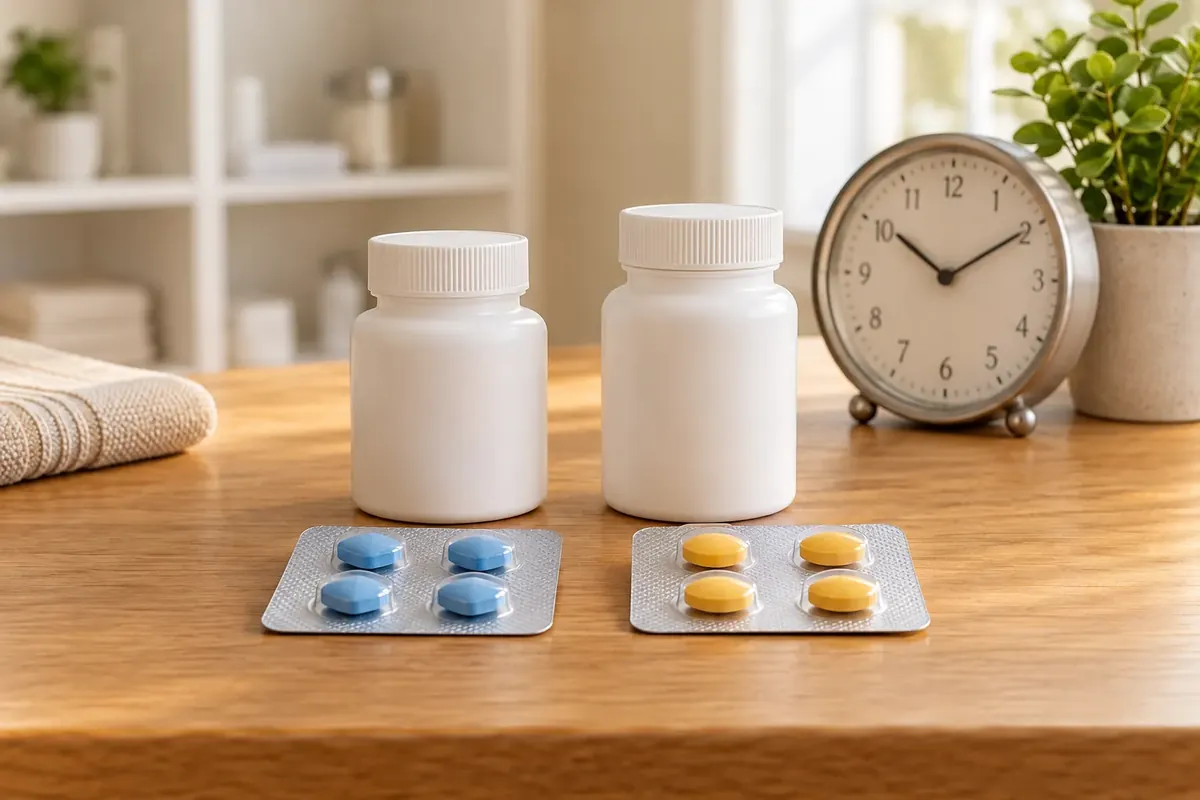 Tadalafil vs Sildenafil: How They Differ and How to Choose
This article is general education, not personal medical advice or a promise of results. Diagnosis and treatment require assessment by a doctor. Content reflects the cited sources as of the update date.